AI is now in attackers' hands too:
what does the FBI's warning mean for healthcare institutions?
In an urgent alert (FLASH) issued on 13 November 2026, the US Federal Bureau of Investigation (FBI) drew attention to an AI-powered attack tool called ARTEX. According to the FBI, in some attacks carried out with this tool, the time from targeting an organisation to gaining administrator-level access fell below three hours.
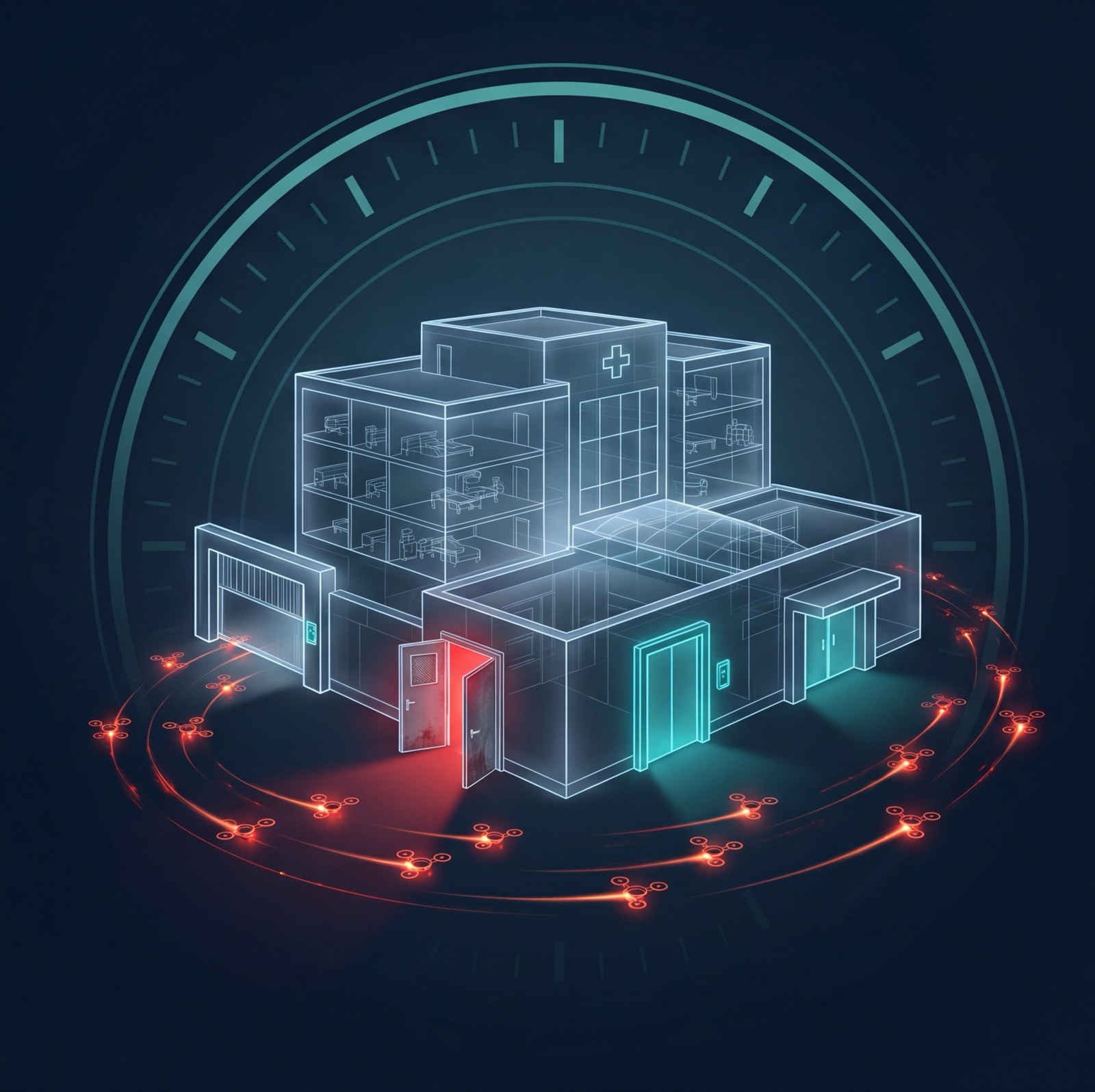
The FBI reports that the tool has been used since at least August 2026 against organisations in the financial, government, technology and defence sectors and against healthcare organisations. The alert does not name a specific hospital confirmed to have been breached with this tool.
In this article we explain what ARTEX is, how the attacks work and what a healthcare institution should take away from this alert.
What is ARTEX?
ARTEX is a penetration testing tool written for security teams to test their own systems, and it was released as open source in July 2026. The tool has no AI model of its own and works by connecting to external large language models. These models act as agents inside the tool. The agents scan the network, look for vulnerabilities, exploit the ones they find, escalate their privileges and move data out.
Its developer removed the source code in October 2026. According to the FBI, the tool continues to circulate through copies, archived versions and a commercial edition. In early November, security researchers identified more than 1,600 ARTEX management consoles exposed to the internet. The FBI states that the tool is widely used by both cybercriminal groups and nation-states.
This shows that an attack chain which an expert team once carried out over a long period can now be run by AI agents within hours.
Which doors do the attacks come through?
The FBI's recommendations and the reported incidents show that attackers mostly use known entry points. ARTEX tries these points much faster. The main entry points are:
- Internet-facing applications and partner portals
- Cloud administration interfaces and management consoles
- Logins that do not use multi-factor authentication
- Access credentials given to vendors and third-party services that were not revoked after the work ended
- Application identities that a service provider uses to connect to customer environments
Examples
According to the FBI, a campaign in South Korea that used ARTEX targeted financial institutions, including major banks, and stole the personal information of about 67,000 people. According to news reports, the breaches were largely caused by weak defences and missing protections such as multi-factor authentication.
In October 2026, in a supply chain attack targeting ConnectWise's cloud backup service, attackers took over the application identities the service used to connect to customer environments. According to news reports, the attackers used ARTEX to try to access more than 2,250 customer environments. ConnectWise said it could not confirm this number. A security company reported that at least 162 customer environments were compromised.
According to news reports, in another ARTEX-linked attack the attackers used a third-party access credential that Barracuda had not revoked after the business relationship ended. After the incident, the company changed all of its customer credentials.
Incidents of this kind have also occurred in healthcare. In the 2024 attack on Change Healthcare in the United States, the attackers got in through a single remote access service without multi-factor authentication. Payment and claims processing was disrupted for about two months, and the number of affected individuals reached about 193 million. Tools like ARTEX mean that the same kind of weakness can now be found much faster.
Why are hospitals especially at risk?
A hospital's digital landscape contains most of the entry points such tools look for. These include the hospital information system, laboratory and imaging systems, device and software vendors that connect remotely, integrations with insurance and public systems, and old services that have not been updated for a long time.
In healthcare, a system outage does more than cause data loss. When Synnovis, which provides laboratory services to hospitals in London, was hit by ransomware in June 2024, blood matching tests were disrupted. According to NHS England, more than 800 planned operations and 700 outpatient appointments at the two most affected hospital trusts had to be rearranged in the first week.
If an attack can reach administrator-level access in less than three hours, a weekly update cycle and logs that are read the next day cannot keep up with that speed.
What should a healthcare institution do today?
When we adapt the FBI's recommendations and the reported incidents to the structure of healthcare institutions, the following eight steps stand out.
- Inventory of internet-facing systems: The institution should list every system exposed to the internet. The list should cover remote access logins, patient and physician portals, imaging system consoles and vendor connections. A system that is not on the list cannot be covered by a protection plan.
- Multi-factor authentication: Multi-factor authentication should be mandatory for all remote access.
- Vendor access: Access credentials given to vendors should be reviewed regularly, and a vendor's access should be closed as soon as its work ends.
- Management interfaces and permissions: Access to management consoles and cloud administration interfaces should be restricted, and each account should have only the permissions its work requires.
- Log monitoring: Logins and permission changes should be monitored continuously. Alerts should be set up for logins at unusual hours, sudden bursts of requests and large data transfers.
- Rate limits: Rate limits should be applied to sensitive application interfaces (APIs).
- Backups: Backups should be kept in a separate environment that attackers cannot reach, and restoring them should be tested regularly.
- Breach plan: Who does what during a breach should be set out in writing in advance. Under decision 2019/10 of Turkey's Personal Data Protection Board, the data controller must notify the Board without delay and within 72 hours at the latest from the date it learns of the breach.
AI should be used in defence too
The story of ARTEX shows two sides of AI. The tool was written to help organisations find their own vulnerabilities. Attackers use the same tool against other organisations' systems. Defence therefore needs the same speed. An institution should test its own systems regularly, monitor its logs with the help of AI and be able to detect suspicious activity within minutes rather than hours.
Attackers now move faster, but the entry points they use remain largely the same. An unrevoked access credential and a portal without multi-factor authentication are among the most common. Closing these points requires regular and disciplined work.
At Opinion AI, we continue to build the systems that process health data with this discipline and to contribute to awareness of this topic in the sector.
We described other risks that healthcare institutions should know when using AI in this article. If you would like to see MINA in your own institution, you can request a POC.
Related: Ethics, data protection and compliance · Information and quality security policy
Sources: FBI FLASH alert, 13 November 2026: BleepingComputer, 15 November 2026; The Record, 13 November 2026; TechCrunch, 16 November 2026; IBTimes UK, 18 November 2026; Change Healthcare: HIPAA Journal; Synnovis: NHS England statement, Security Affairs, June 2024; 72 hours: Personal Data Protection Board decision 2019/10. We adapted the steps for healthcare institutions from the FBI's recommendations. Information about companies is given as reported in these articles.
SSS
What is ARTEX?
ARTEX is an open-source penetration testing tool written for security teams to test their own systems. It works by connecting to external large language models, which act as agents to scan networks, exploit vulnerabilities, escalate privileges and move data. The FBI reported its use by attackers in its urgent alert of 13 November 2026.
Does the FBI's warning cover healthcare institutions?
Yes. The FBI lists healthcare among the sectors in which the tool has been used. The alert does not name a specific hospital confirmed to have been breached with this tool.
How quickly must a data breach be reported under KVKK?
Under decision 2019/10 of Turkey's Personal Data Protection Board, the data controller must notify the Board without delay and within 72 hours at the latest from the date it learns of the breach.
