
Home

Success stories

We work alongside insurers and healthcare institutions in live operations. We formed a strategic collaboration with AXA Sigorta on its pre-authorization processes and were one of seven startups selected for HackZone by Allianz, Allianz Türkiye's open innovation program. At more than one large private hospital group in Türkiye, we run as an intelligent layer on top of HBYS, and we have started POCs with a number of hospital groups in Northern Europe. Below, we describe this work and our input to Türkiye's Artificial Intelligence Action Plan. In all of it, people make the decision; AI shows its rationale and the source it relies on, and every output can be audited afterwards.

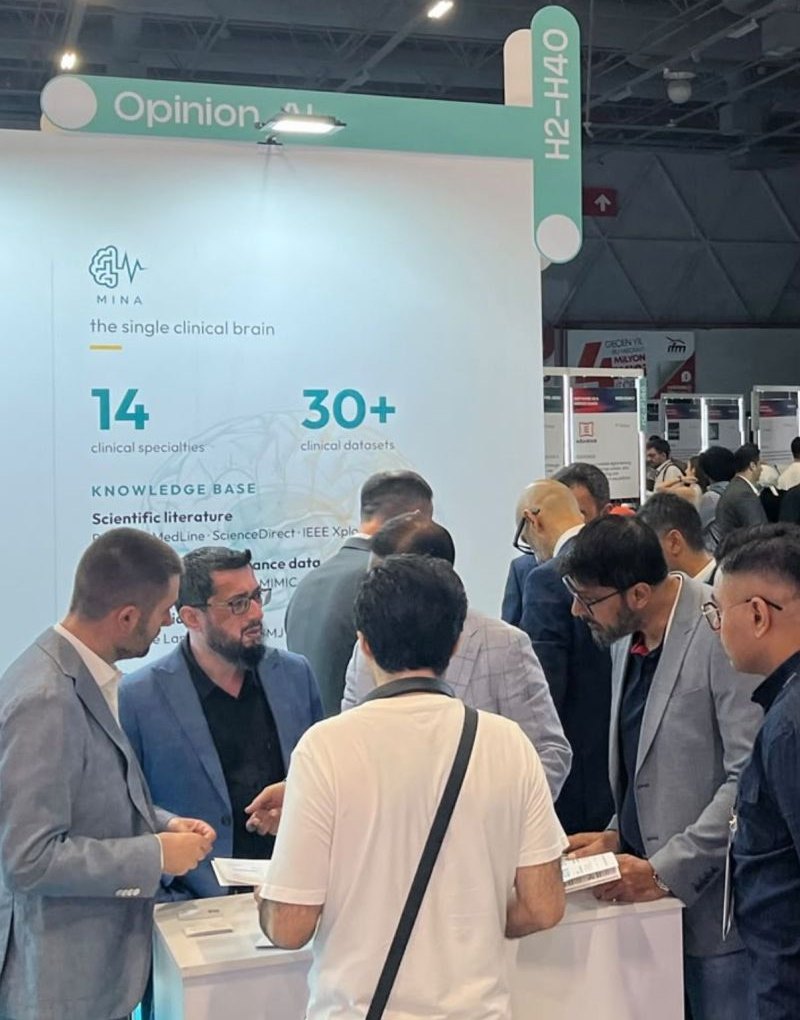
Opinion AI's stand at GITEX AI Türkiye in Istanbul, with visitors talking and looking through brochures in front of the MINA display panel
A health insurance specialist reviewing a pre-authorization file beside a screen showing clinical images

Clinical decision support in AXA Sigorta's pre-authorization processes

In health insurance, pre-authorization is a decision made against the clock. When a hospital submits a request, the specialist has to weigh coverage, waiting periods and exclusions, previous pre-authorizations, the remaining limit and the clinical documents sent by the hospital, all at once. That information often sits on different screens, and routine files wait in the same queue as the cases that genuinely need an expert eye.

We formed a strategic collaboration with AXA Sigorta. Under this collaboration, Opinion AI's AI-based clinical decision support system, grounded in scientific evidence, is being integrated into AXA Sigorta's pre-authorization processes. The aim is to improve the quality and speed of decisions in pre-authorization review, and to give policyholders faster and more transparent service.

The system checks whether the diagnosis and the requested procedures align with current medical guidelines and, on that basis, analyzes medical necessity. For rare diseases, it provides specialist-level insight from the literature. For every request, it supports its recommendation with citations and references from the scientific literature, so the rationale is visible and transparent. It tracks developments in the medical literature and keeps its knowledge base up to date. Digital twin technology brings together the patient's complete data and the physician's decision model.

At the pre-authorization stage, SIT-I brings coverage and clinical documents together on a single screen. The file reaches the specialist ready to review, with a policy analysis covering coverage, waiting periods and exclusions, the used and remaining limits, previous pre-authorizations and their amounts, SUT compliance (SUT is the reimbursement rulebook of SGK, Türkiye's Social Security Institution) and clinical observations on the same page. Specialists can query a file the way they would consult a colleague, asking for example "What should I not miss with this patient?", and receive the answer through Doctor Assistant or Council Mode.

The final decision always rests with AXA Sigorta's medical specialists. Compliance with the rules is assessed in the rule engine, and the AI shows its reasoning and its sources; what comes from the documents and what the model infers are kept visibly apart in every answer. Routine checks run automatically, and the specialist's attention stays on complex cases.

  • Science-based clinical decision support is being integrated into AXA Sigorta's pre-authorization processes.
  • Diagnoses and requested procedures are checked against current medical guidelines, and medical necessity is analyzed.
  • Specialist-level literature insight is provided for rare diseases, and every recommendation is backed by scientific citations and references.
  • At pre-authorization, policy analysis, limit tracking, file history, SUT compliance and clinical context appear on the same page.
  • The digital twin brings together the patient's complete data and the physician's decision model.
  • The final decision is always made by AXA Sigorta's medical specialists.
“This model, in which the final decision always rests with our AXA Sigorta health specialists, will both increase our operational efficiency and help us put our empathy assurance approach in healthcare into practice more strongly.”Yavuz Ölken, CEO of AXA Sigorta · Anadolu Agency, 26 November 2025 (translated)

In the press (in Turkish): Anadolu Agency · Sigorta Medya · Sağlık Aktüel
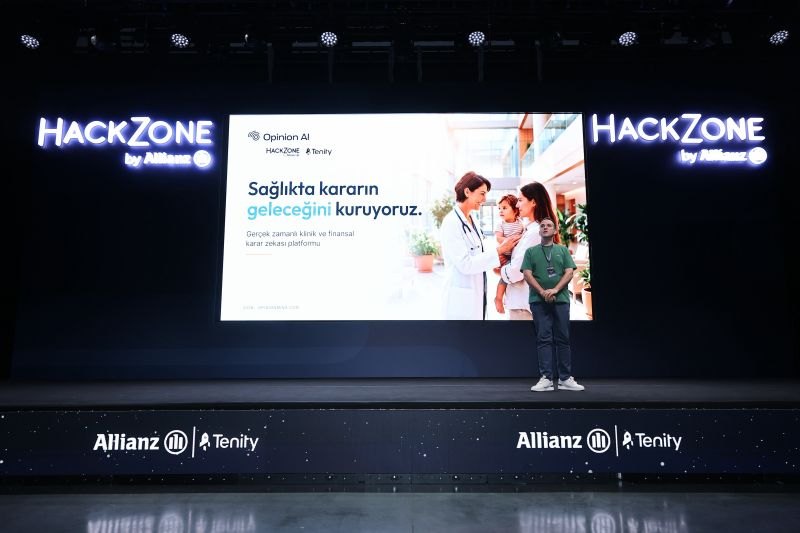
Opinion AI presenting on the HackZone by Allianz Demo Day stage, with a speaker in front of a slide reading “Sağlıkta kararın geleceğini kuruyoruz.” (We are building the future of decision-making in healthcare)

One of seven startups selected for HackZone by Allianz Türkiye

HackZone by Allianz is the Turkish insurance sector's first open innovation program, run by Allianz Türkiye together with Tenity since 2020.

In February 2026, we were one of seven startups selected from nearly a hundred applications for the program's 6th cohort. Throughout the program, we worked on a POC together with Allianz teams.

The 6th cohort's Demo Day took place on 16 September 2026. On stage, we presented our vision for the future of decision-making in healthcare, the MINA model and our platforms. At the center of our presentation was data-driven, trustworthy decision support where healthcare and insurance meet. In its report on the seven startups that took the Demo Day stage, eGirişim described Opinion AI as "supporting healthcare institutions and insurance companies in diagnosis and treatment processes with digital twins and big data analytics" (translated).

At Demo Day, we were also guests on NTV Tekno Hayat, where we talked about our goal of transforming health insurance in the segment titled "Sağlık Sigortasını Dönüştüreceğiz" ("We will transform health insurance"). MINA is a healthcare AI we have been developing for five years, adapted to Turkish and to the clinical language of 14 specialties. It was designed not as a chatbot but as a solution integrated into the institution's own systems, and it runs in a closed environment that complies with KVKK, Türkiye's personal data protection law, and the GDPR. We also discussed why speed and clinical decision accuracy both matter in processes where every second counts.

  • HackZone by Allianz is the Turkish insurance sector's first open innovation program and has been run with Tenity since 2020.
  • In February 2026, we were one of seven startups selected from nearly a hundred applications for the 6th cohort.
  • We carried out POC work with Allianz teams throughout the program.
  • We presented MINA and our platforms on stage at Demo Day on 16 September 2026.
  • On NTV Tekno Hayat, we explained that MINA is integrated into the institution's own systems and runs in a closed environment compliant with KVKK and the GDPR.

In the press (in Turkish): eGirişim · Sigortacı Gazetesi · NTV Tekno Hayat (YouTube)

A physician and a hospital manager reviewing patient data on a tablet in a hospital corridor

An intelligent layer over HBYS at large private hospital groups in Türkiye

In a hospital, information about the same patient is spread across several places: admissions and procedures in HBYS, the hospital information system; pre-authorization and billing in Medula, SGK's provision and billing system; clinical detail in free-text discharge summaries and reports. A missing document, an incorrect ICD-10 code or an item that does not comply with SUT often surfaces only after the invoice has gone out, as a rejection. And replacing HBYS is not something any hospital takes on lightly.

At more than one large private hospital group in Türkiye, TIS runs as an intelligent layer on top of the HBYS each group already uses, without changing it. HBYS and Medula data come together in a single live patient profile: the patient's digital twin. Discharge summaries and reports are converted into structured fields, and ICD-10 coding and SUT checks run on that profile. SGK/Medula billing errors and SUT non-compliance are flagged before invoicing and before payment.

Data stays inside each hospital, KVKK-compliant masking is applied (KVKK is Türkiye's personal data protection law), and the hospital itself remains the data controller. Deployment starts with a single module and grows module by module as needed. TIS modules map to different points in the hospital workflow. Pre-authorization runs on a single panel together with a risk score, and a clinical assistant steps in for ICD-10 coding, SUT checks and discharge summaries. The audit cockpit tracks BH and ADSH indicators, the MKYS module issues inventory alerts, and the medical accounting module follows collected, pending and rejected amounts.

With this setup, the order of work changes. Pre-authorization starts from a ready clinical synthesis rather than a blank file; gaps are flagged before the claim is submitted; audit indicators are monitored continuously, not only on audit day. Management follows the process from the same cockpit as the operational teams.

  • In each hospital group, HBYS stays as it is; the intelligent layer is added on top of the existing system.
  • HBYS and Medula data come together in a single live patient profile.
  • Discharge summaries and reports are turned into structured fields, and ICD-10 coding and SUT checks run on that profile.
  • Billing errors and SUT non-compliance are flagged before invoicing and before payment.
  • Data stays inside each hospital and is masked in line with KVKK.
  • Deployment starts with a single module and grows module by module as needed.
Group photo of entrepreneurs and ecosystem representatives at the Terminal Istanbul Ecosystem Meeting

POCs with hospital groups in Northern Europe

We have been developing AI for healthcare for five years, working in the field with hospitals and insurers in Türkiye. We are now taking the same work beyond Türkiye. We have started POCs with a number of hospital groups in Northern Europe, and that work is ongoing.

MINA's architecture is the foundation of this work. Its open-weight base model was adapted to Turkish and to the clinical language of 14 specialties through continued pre-training (CPT), and specialty, institution and task expertise is added through LoRA adapters. The same design allows the model to be adapted to languages other than Turkish and to different health systems, and institution- and task-specific adapters make it possible to specialize the model for each hospital group's own needs.

Data stays in each institution's own environment. Opinion AI does not collect personal data, and each hospital group always remains the data controller for its own data. MINA runs in a closed environment that complies with the GDPR, just as it complies with KVKK in Türkiye. Here too, people make the decision; AI shows its rationale and the source it relies on, and every output can be audited afterwards.

  • We have started POCs with a number of hospital groups in Northern Europe, and the work is ongoing.
  • MINA's base model is adapted through continued pre-training, with institution and task expertise added through LoRA adapters; this architecture can be adapted to other languages and health systems.
  • Data stays in each institution's own environment; Opinion AI does not collect personal data.
  • MINA runs in a closed, GDPR-compliant environment.
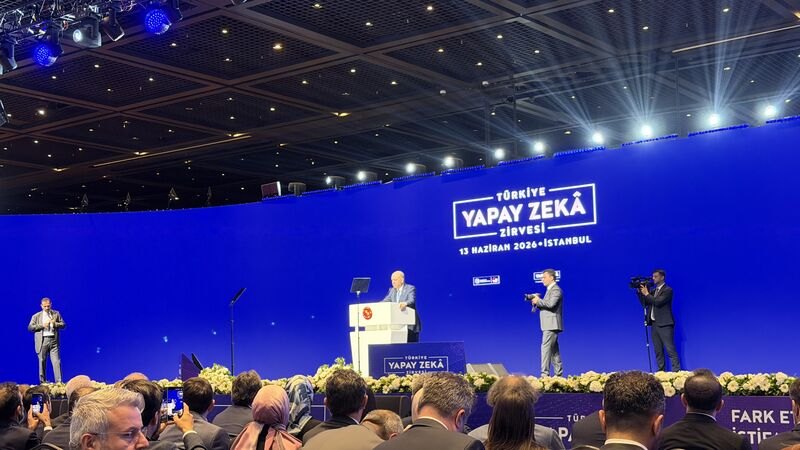
A speaker at the podium at the Türkiye Artificial Intelligence Summit, with a blue backdrop reading “13 Haziran 2026 · İstanbul” (13 June 2026, Istanbul) and an audience in the front rows

Contributing to Türkiye's Artificial Intelligence Action Plan

How AI is used in healthcare is not only a technical question. Where data is kept, who holds the decision and which rules govern new technology are settled at the level of national policy. In Türkiye, that framework is set by the 2026–2030 Artificial Intelligence Action Plan.

During the plan's preparation, we contributed our views to the roadmap as an industry stakeholder. The measures we proposed (risk-based regulation, alignment with the EU, anonymized data sharing and regulatory sandboxes) were included in the 2026 Action Plan.

The plan was announced by the President in June 2026 at the Türkiye Artificial Intelligence Summit at Tersane Istanbul, where Opinion AI took part as an invited guest. Coordinated by the Ministry of Industry and Technology, it was published in the Official Gazette on 18 August 2026. Health is among its priority areas, and data sovereignty, a human-centered approach and trustworthy AI are now principles set at the level of national policy.

For us, the plan's "produce" and "govern" pillars describe a national AI infrastructure for healthcare that delivers clinical decision support, complies with regulation and keeps data in the country. We build MINA on the same principles. Data stays inside the institution, people make the decision, and every output can be audited afterwards.

  • We contributed our views as an industry stakeholder during the Action Plan's preparation.
  • The risk-based regulation, EU alignment, anonymized data sharing and regulatory sandboxes we proposed were included in the plan.
  • The plan was announced at the Türkiye Artificial Intelligence Summit in June 2026.
  • The plan was published in the Official Gazette on 18 August 2026, and health is among its priority areas.

Milestones in the field

Below is a short summary of the programs, trade shows and ecosystem gatherings we have recently taken part in; you can find the details of each on the News page.

A POC on your own process

Every institution's process is different. We scope the POC together around one step of your process, with your data staying inside your institution; we start with a single module and extend as needed.

POC Request