TIS brings a patient's records together
in one digital twin.
Reaching the right diagnosis is often delayed because information is scattered. A patient's past visits, lab results, imaging reports and discharge summaries sit in different systems.
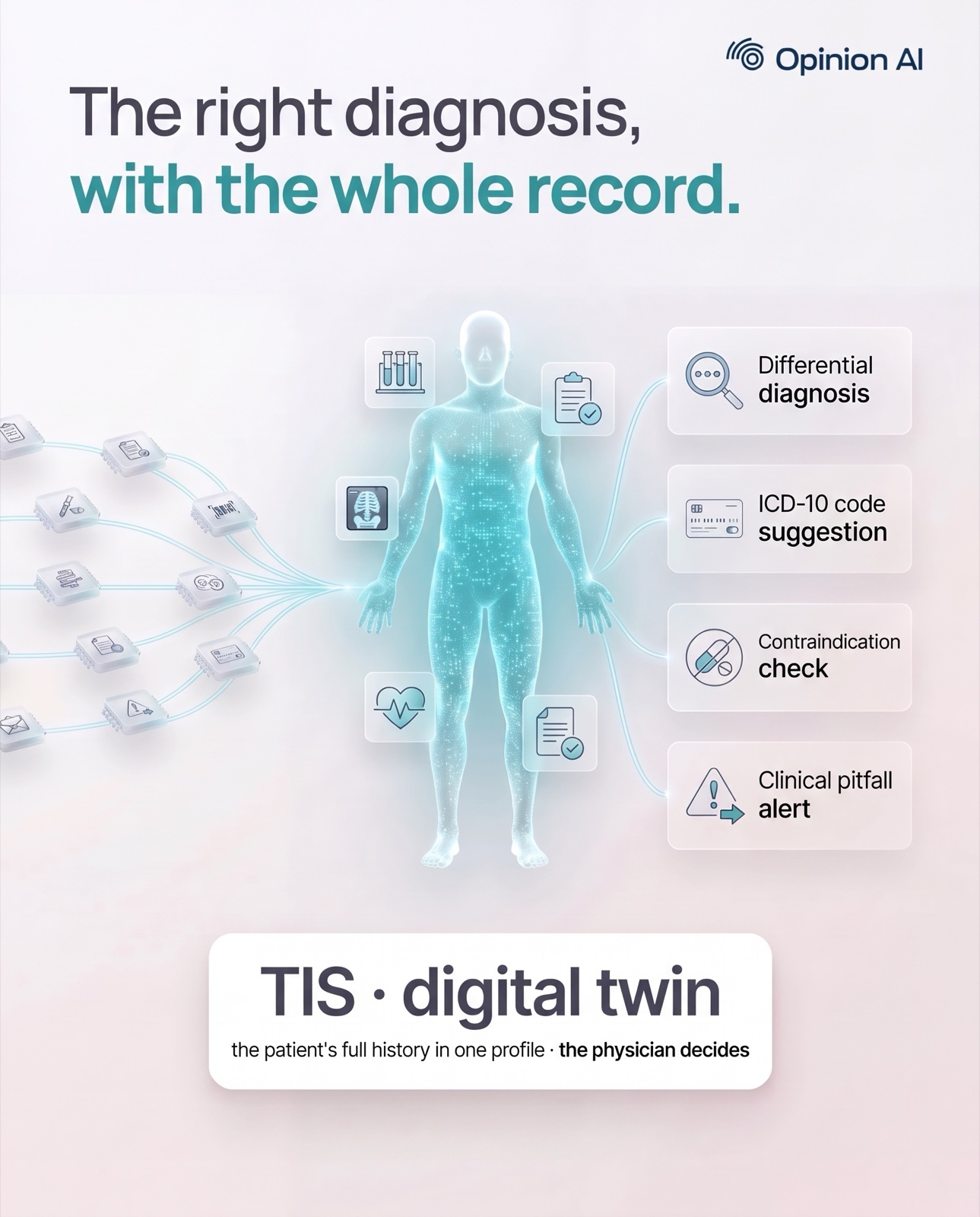
TIS brings these records together in the patient's digital twin, a single live profile. When physicians open a patient's record, they do not have to search for the patient's history.
What MINA brings to the physician
MINA reads the patient's digital twin and presents the following to the physician, each with its rationale and source.
- Differential diagnosis suggestions
- The appropriate ICD-10 code
- Drug contraindications
You can find MINA v3.7's results in differential diagnosis, ICD-10 coding, contraindication and clinical pitfall evaluation on the MINA v3.7 page.
The physician makes the diagnosis
The physician always makes the diagnosis. With TIS, physicians can spend the time they used to spend searching for records on the decision itself. TIS runs in the hospital's own environment, and data does not leave the hospital.
You can read what TIS offers physicians on the TIS for physicians page and how it works in the hospital on the TIS for hospitals page. If you would like to see it in your own institution, you can request a POC.
Related: TIS for physicians · TIS for hospitals · MINA v3.7
SSS
What is a patient's digital twin?
A patient's digital twin is a record that brings the patient's past visits, lab results, imaging reports and discharge summaries together in a single live profile. TIS builds this profile from the patient's records at the institution.
Does MINA make the diagnosis?
No. MINA presents differential diagnosis suggestions, the appropriate ICD-10 code and drug contraindications with their rationale and source. The physician always makes the diagnosis.
Does patient data leave the hospital?
No. TIS runs in the hospital's own environment, and data does not leave the hospital.
